
A 6.2-Tsubo Café Bar, Open Weekday Evenings Only: ¥279,130 in Month Four — Guest Count Rose from 70 to 82 While Average Spend Fell from ¥4,219 to ¥3,404
Real figures from a 6.2-tsubo café bar that opens only 17:00–22:30 on weekdays. In October 2025, month four, it took ¥279,130 from 82 guests across 21 trading days. Guest count was up on month two, yet revenue was down: average spend had fallen from ¥4,219 to ¥3,404.
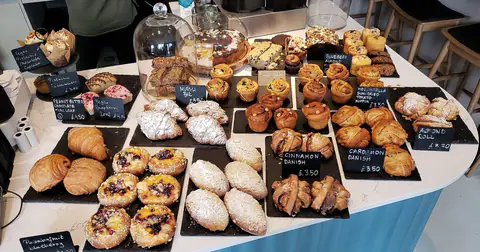
Numbers published in restaurant opening diaries usually come from after the business has found its footing. You may get a breakdown of several million yen a month, but rarely how many people walked in during the first month and how much they each spent. A series on note called “Café Bar Opening Miscellany,” written by an operator using the handle Minarai Tenchō (“apprentice manager”), publishes exactly that, month by month.
The shop is 6.2 tsubo, about 20 square metres, a ground-floor unit with good visibility in central Tokyo. It trades from 17:00 to 22:30 on weekdays and closes on weekends and public holidays. Under those conditions, October 2025, the fourth month after opening, produced ¥279,130 in sales, from 82 guests over 21 trading days. The target had been ¥300,000, so it fell short.
These are small figures. But the case is worth reading less for the size of the number than for the movement that appears when you put month two and month four side by side.
Month two next to month four
| Item | Aug 2025 (month 2) | Oct 2025 (month 4) |
|---|---|---|
| Sales | ¥295,300 | ¥279,130 |
| Guests | 70 | 82 |
| Trading days | 20 (one with no guests) | 21 |
| Average spend (sales ÷ guests) | approx. ¥4,219 | approx. ¥3,404 |
| Sales per trading day | approx. ¥14,765 | approx. ¥13,292 |
| Guests per trading day | 3.5 | 3.9 |
Guest count rose 17%, from 70 to 82. Sales nonetheless fell by ¥16,170. The cause is average spend, down 19% from about ¥4,219 to about ¥3,404.
A line the operator wrote in the month-two instalment explains the movement: at that point many of the customers were people he knew, and he was aware the situation amounted to a “cheat.” Immediately after opening, friends and acquaintances turn up in a celebratory frame of mind and spend loosely. Average spend lifts temporarily. Once that cohort has cycled through, it returns to its natural level.
Which means ¥3,404 in month four is closer to the shop’s real number. Read the opening months as “a strong start” and you will have no way to explain the drop three months later. Recording guests and spend separately means you never confuse a fall in traffic with a fall in ticket. In this shop’s case, traffic actually improved.
Designing around not opening
What defines this shop is how much of the week it stays shut. Weekdays only, 17:00 to 22:30, closed weekends and holidays. Conventional restaurant wisdom says weekends are the biggest earner. This business throws them out entirely.
Targeting weekday evenings in a central ground-floor unit means restricting the customer base almost entirely to people on their way home from work. In an area that empties out at weekends, opening simply drains labour and utility costs. More trading days raises revenue but does not necessarily raise profit — building that judgment in before opening is the structural core of this case.
The same design also caps the upside. 6.2 tsubo, 5.5 hours a day, 21 days a month. At 3.9 guests per trading day, the constraint isn’t that seats go unfilled. It’s that the number of people the operating conditions can admit at all is small. Among comparably tiny shops, the crêpe stand in five tsubo that reached ¥1M a month and still couldn’t continue built revenue through daytime turnover. Whether you earn on turns or on ticket is decided by operating design, not floor area.
Cost ratios calculated on paper drift in practice
By month two, the operator was writing that his cost of goods ratio was running higher than his projections. The example he gives is wine. He had built his costing on six glasses per bottle. In practice it often comes out at five.
That is one glass, roughly a 17% yield gap. In by-the-glass service, pouring technique, foam and accumulated waste land directly on the cost ratio. Pre-opening projections have to be built from catalogue figures, so this kind of drift is hard to avoid. Put the other way round: the first few months after opening are a period of checking your projections against reality, and without a record you cannot correct your pricing.
Utilities, he notes, came in within the expected range. Cost of goods missed, fixed costs landed.
Supply terms were arranged before opening. The liquor supplier delivers the day after ordering, at prices below retail. Setting up that account required seven documents: a residence certificate showing permanent domicile, a seal registration certificate, a corporate registry extract, the company’s seal certificate, the guarantor’s residence certificate and seal certificate, and a copy of the operating licence. A 6.2-tsubo shop can only hold so much stock, so whether next-day delivery works determines how you hold inventory at all. Divide ¥279,130 by 6.2 tsubo and you get roughly ¥45,000 per tsubo. At this scale, what you can physically store tends to cap what you can sell. Locking in fast replenishment terms first is, for a very small shop, the same thing as choosing not to carry inventory risk.
Buying down the risk of closing, in advance
The funding structure is distinctive too. Rather than operating as a sole proprietor, the operator incorporated: registration costs of “¥220,000 and a bit,” with ¥2,000,000 in capital. A crowdfunding campaign ran before opening. A soft opening began on June 29 at roughly three days a week, then moved to full trading.
Against monthly revenue of ¥279,130, ¥2M of capital is not thick. But as a buffer that prevents a first-year loss from immediately forcing closure, it is one implementation of starting small. The operator also runs a separate business he has kept going for eight years. This shop was never designed to support a household on its own.
Small shops that failed to cover fixed costs are common. As with the two rental-space locations that ran at a loss over 29 months, the danger in physical retail is the slow grind of the gap between fixed cost and revenue, and the first hurdle is holding enough cash to withstand it while keeping living expenses on a separate ledger.
Three columns of sales, guests and days, and a 6.2-tsubo ceiling
The most informative thing in this series isn’t the amount but the granularity of the record. Because sales, guest count and trading days are published together every month, a change like a falling ticket becomes visible. Track only revenue and all you get is “down from month two,” with no way to tell whether the cause is traffic or spend. Assume opening figures are distorted by people you know, then go looking for the level after that distortion clears. Those three columns are what make that reading possible.
The ceiling is set from the start, too. At 6.2 tsubo and weekday evenings only, the revenue ceiling is fixed in advance. In the month-four instalment the operator writes that sales look like they will settle around this level each month. The business isn’t being run on the premise of growth. As with the yakitori takeaway started on ¥500,000, starting small is a design for keeping losses small, not a promise of growth.
And the figures here are just two data points, August and October 2025. The operator himself notes that February and August are hard months in food service, so seasonality cannot be ignored. That said, the series has continued, including an instalment marking the first anniversary. In a category where closing within a year is unremarkable, the fact that the shop is still trading past the one-year mark is itself a result, and should be read alongside the ¥279,130.
If this one impressed you
Similar cases

Cafe Verrine: ¥1M in the red by month 3, ¥1.2M in sales by month 5
Offline
nephew: A Yoyogi-Park Café and Bar Discloses ¥39.96M in Its First Nine Months — 101 Guests at ¥1,294 by Day, 37 at ¥3,170 by Night
Offline
Okashi Kaigyo Lab: a 13-tsubo cake shop booked ¥27,073,172 in year three and published every monthly sales figure to the yen
Offline
Income of ¥1.57M in year one of farming, ¥2.42M of which was subsidies. A bag of bok choy at ¥120 was priced below cost
OfflineMost read
- 1
¥4.61 Million a Year, Five Years After Starting to Learn Programming. The Full Three-Year P&L and Playbook of an Indie Education App
33 recent visits - 2
Payout: A Class-Action App Vibe-Coded in 14 Days Reached $1,003,227 ARR in 9 Months. It Cost About $10 to Build, and a Partner With 10 Million Followers Grew It
32 recent visits - 3
Easy Folders: One Chrome Extension, $3,700 MRR and $42,000 Lifetime Revenue in 6 Months — a “Fill the Gap” Structure
24 recent visits - 4
Starter Story: The $91.7K/Month Startup Case-Study Media Acquired by HubSpot — Months After the Founder Tweeted "HubSpot Should Acquire Starter Story"
24 recent visits - 5
From 30 yen in revenue to 8 years later: how running 3 apps in parallel got an indie developer to 200,000 yen a month
21 recent visits
Latest articles
- 2026-11-02
Omameya: ¥2.26M Monthly Revenue Six Months After Opening, From a Location the Owner Calls "Not Even Good"
- 2026-11-01
Hana: ¥7.5M in year three, saved by ¥200K a month
- 2026-11-01
Write With AI: $400K ARR From 114,000 Readers, With Under 2% Paying
- 2026-10-31
lemlist: A French SaaS Started on $1,000 Reached $28M ARR — and a $150M Valuation Without a Cent of VC
- 2026-10-31
Apollo for Reddit: One Price List Ended a Solo App With 1.5M Monthly Users — a Projected $20M a Year, and $250,000 in Refunds
Sources
- Founder 運営者「みならい店長」による連載「カフェバー開業よもやま話」#21(2025年11月9日、全文無料)。開店4か月目にあたる2025年10月の売上279,130円・来店82名・営業21日と、目標30万円に届かなかった経緯を公開
- Founder 同連載#15。開店2か月目(2025年8月)の売上295,300円・来店70名・営業20日、初年度の試算が月30万円だったこと、原価率が試算より高いこと、ワイン1本あたりの提供杯数が想定6杯に対し実際5杯であることを公開
- Founder 同連載#5(2025年6月6日)。個人事業ではなく株式会社を選んだ経緯、登記費用「22万円とちょっと」、資本金200万円、6.2坪という店舗規模を記載
- Founder 同連載#9。6月29日からのプレオープン(週3程度)、都心の視認性が良い1階店舗という立地、酒屋との取引条件(前日発注で翌日納品・店頭価格より安く仕入れ)を記載
- Founder 運営者のnoteアカウント。連載は#48まで継続し、一周年記念の回も投稿されていることから開業から1年以上の営業継続が確認できる