
A takeout yakitori shop opened for about ¥500,000. A 9-item cost breakdown, and what "paid back in under 2 months" actually means
A current owner running a takeout-only yakitori shop in Osaka published a breakdown of his roughly ¥500,000 opening cost from about 15 years ago — a ¥50,000 grill, two ¥20,000 used fridges, ¥220,000 in property costs. He paid it back in under two months, with a realistic take-home around ¥400,000/month.
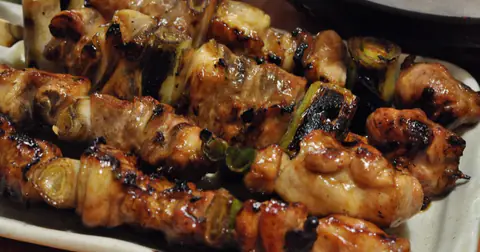
The conventional wisdom on restaurant startup costs starts in the millions of yen. Against that backdrop, a current shop owner posted “you can start with ¥500,000.” He runs a takeout-only yakitori shop in Osaka, open for about 15 years, and published an itemized breakdown of his opening costs. The same post also carries a caveat: “this isn’t a business where just anyone succeeds” and “run it carelessly and you’ll fail just the same as anyone else.” Here’s the cost breakdown and the structure it reveals.
The opening-cost breakdown
| Item | Cost |
|---|---|
| Grill | ¥50,000 |
| Refrigerator (used) | ¥20,000 × 2 units |
| Freezer (no-brand) | ¥50,000 |
| Work table | Used the tops of the fridge/freezer units (no added cost) |
| Display case (initially a plain glass case) | ¥20,000 |
| Skewers / cooking tools (mostly from a ¥100 shop) | ~¥30,000 |
| First meat purchase | ¥20,000 |
| Interior (DIY) | ~¥50,000 |
| Deposit, rent, real-estate agent fee, etc. | ¥220,000 |
| Total | ~¥500,000 |
All figures are from roughly 15 years ago, and the owner himself notes that “prices have gone up since then, so the same setup would cost more today.” Even so, he positions it as “a realistic figure if you’re starting small.”
What the breakdown reveals when you dig into it
Of the roughly ¥500,000 total, the single largest line item is the ¥220,000 in deposit, rent, and agent fees, over 40% of the total. Equipment (the grill, two fridges, freezer, and display case) totals ¥160,000, three of which are used or no-brand items. Tools were mostly sourced from a ¥100 shop for about ¥30,000, and DIY interior work cost about ¥50,000. Everything besides the pure “box” itself fits within under ¥300,000.
The interior coming in at ¥50,000 has a structural reason: this is a stall-like format built for takeout only, with no seating. No seating means no need for the costs seating requires, interior aesthetics, air conditioning, restrooms, floor area for customers. Restaurant opening costs typically balloon not from kitchen equipment itself, but from the space investment needed to make customers comfortable staying. This shop eliminated that entire line item at the format-selection stage.
No dramatic turning point in this case
Reading through the post, there’s no single event where this shop can be said to have “found its footing.” If anything, the owner says the opposite: “this isn’t a business where you suddenly strike it rich. It’s steady, one skewer at a time.” “The most important thing is to keep going.” There wasn’t a turning point. What he actually built was a cost structure that didn’t need one.
Two things did the work. One was the format choice: going takeout-only with no seating compressed both initial investment and ongoing fixed costs at once. The other was his sourcing policy: “buy used when used is fine.” Using the tops of the fridge and freezer as a work surface is the clearest example. A dedicated work table would have cost several tens of thousands of yen; a small configuration tweak brought that to zero.
What “paid back in under 2 months” tells you when you work backward
The owner writes that he “recovered the opening costs in under two months.” A simple back-of-envelope calculation: recovering roughly ¥500,000 in under two months requires take-home profit of roughly ¥250,000+ a month. That means he was already at that level right from opening, a sign that, at minimum, a slow ramp-up wasn’t an issue for this business.
This is the essence of low-capital opening. If the amount to recover is ¥500,000, ¥250,000/month in profit means payback in 2 months. At the same profit level, a ¥5 million initial investment would take 20 months. Keeping opening costs low does more than reduce the cash needed upfront. It shortens the time until you know whether the business is viable, and it caps the downside if the decision turns out wrong. In this owner’s case, the worst-case loss is ¥500,000 and a few months, a bet sized within a range you can walk away from.
What this ¥500,000 doesn’t include
Reading the breakdown at face value, it’s worth flagging what’s not listed. The nine line items cover equipment, tools, first inventory purchase, interior, and the property lease, nothing else. Restaurant licensing/permit fees, additional signage or fixtures, working capital to cover rent and utilities for the early months, and the owner’s own living expenses all sit outside this ¥500,000.
¥500,000 is the cost of getting the shop into a state where it can sell yakitori, not the cost of surviving until sales actually materialize. That the opening cost was recovered in under two months implies, conversely, that he had some other source of funds to get through those two months. Low-capital openings typically fail not because equipment can’t be bought, but because cash runs out before sales get going. If you’re using ¥500,000 as a benchmark for planning, it’s reasonable to budget an equal amount or more, separately, as working capital.
What can’t be taken at face value
At the same time, this post is written conservatively about the earning potential. The owner states plainly: “if you want to take home ¥1 million a month, this isn’t for you,” drawing the realistic ceiling at “around ¥400,000. That’s genuinely achievable if you run it right.” He also adds, “I’ve experienced that failure myself,” implying not all 15 years went smoothly.
There are numerical constraints too. The ¥500,000 figure is a roughly-15-year-old acquisition cost. Equipment, ingredients, and real estate won’t line up at the same prices today. The ¥220,000 deposit/rent/agent-fee figure in particular depends heavily on region and property terms, with no guarantee the same square footage under the same conditions can be found at the same price today. The post doesn’t disclose revenue, average ticket price, days open, or cost-of-goods ratio, what scale of sales the ¥400,000 take-home figure corresponds to isn’t stated.
What’s reproducible, and what isn’t
What’s easy to transplant is the mindset: choose a format that doesn’t require seating to eliminate interior costs. Buy used equipment for anything that doesn’t affect function. Substitute existing items for dedicated fixtures. These three apply to any small physical-goods business, yakitori or otherwise. Designing a short payback window and setting an exit line in advance is the same idea in a different form.
What’s hard to reproduce is the fact of 15 years of continued operation itself. The process of building a regular customer base until sales stabilized is compressed, in the post, into the single phrase “as I kept at it”, how many months or years that actually took isn’t stated. Taking just the ¥500,000 figure and reading it as “anyone can start this” is exactly the reading the owner himself pushes back on at the outset. Being able to start on low capital and being able to keep going are best treated as two separate problems.
Related reading
- 4 months with a food truck — startup costs for a food business without a physical storefront.
- Running a rental-space business — another version of starting small and keeping fixed costs down.
If this one impressed you
Similar cases

Mirai Shokudo: A Jimbocho Diner That Published 4 Years of Books — ¥34,000 a Day, 23% Food Cost
Offline
Starting a takoyaki food truck cost 2.82–4.39 million yen — a working owner's full line-item breakdown
Offline
A 23-year-old's 17-square-meter crepe shop topped ¥1M/month. Why the profitable owner still called it a "failure"
Offline
Full numbers from 3 rural minpaku properties: a leased + inn-license property paid back in 17 months on 3.45 million yen upfront — double the yield of a Housing Business Act property
OfflineMost read
- 1
Payout: A Class-Action App Vibe-Coded in 14 Days Reached $1,003,227 ARR in 9 Months. It Cost About $10 to Build, and a Partner With 10 Million Followers Grew It
43 recent visits - 2
Starter Story: The $91.7K/Month Startup Case-Study Media Acquired by HubSpot — Months After the Founder Tweeted "HubSpot Should Acquire Starter Story"
35 recent visits - 3
Instatus: $48K MRR with Every Metric Public, After Dropping "Sup" and Repricing Upmarket
23 recent visits - 4
From 30 yen in revenue to 8 years later: how running 3 apps in parallel got an indie developer to 200,000 yen a month
20 recent visits - 5
¥4.61 Million a Year, Five Years After Starting to Learn Programming. The Full Three-Year P&L and Playbook of an Indie Education App
19 recent visits
Latest articles
- 2026-10-20
An 18-Year-Old French Pâtisserie Changed Hands for ¥8M With 1–2 Weeks Left Before Closing — And the 29-Year-Old Buyer Never Negotiated the Price
- 2026-10-20
Traffic Think Tank: a six-year side-hustle SEO community sold for $1.8M, with 40% paid later
- 2026-10-20
Doing Content Right: After Four Side Projects That Made $0, a $99 Ebook Did $130K in Eight Months
- 2026-10-20
Ali Abdaal: Of $5.5M in 2023 Business Revenue, $3.5M Came From Courses — YouTube Was the Funnel, Not the Product
- 2026-10-19
Ozeki Sangyo: A Factory "Two Months From Death" Changed Hands for ¥13M — ¥11M of It an Apartment, Not Cash